Howard League blog · 28 May 2026
Choosing how many to imprison: Some lessons from the 20th century history of English prisons. (Part 1 of 2)
The prison population reached a record high of over 88,000 in August 2024. Widely billed as a crisis, prison capacity pressures have prompted broad-brush and in-depth reviews of prison and criminal justice policy (including the independent sentencing review, independent review of the criminal courts and Dame Anne Owers’s review of prison capacity).
The government has taken some steps to try to ease capacity through the Sentencing Act (including the use of early release schemes, changes to short, suspended and deferred sentences, changes to fixed term recalls and expanded use of electronic tagging) and have also announced a commitment to prison building. However, prison population projections predict continued growth, and analysis of the above measures suggests that, ultimately, no place savings will be made.
How did we reach this point? This two-part blog series charts the fall and rise of the prison population over the 20th century, from a low of under 10,000 to over 80,000 people, and highlights some of the key factors determining just how many people were incarcerated in England and Wales. These blogposts will show how, rather than being a necessary response to rising crime rates, the expansion of the prison population has instead resulted from political will.
Broadly speaking the period can be divided into three: the period between 1900 and 1940, characterised by a declining prison population maintained for over two decades at much reduced levels; the period from 1940 to 1993, which showed a steady increase; and the period after 1993, which showed a dramatic increase. Having researched each of the three periods it is clear that a number of factors from austerity to public attitudes impacted imprisonment rates, but the most significant driver across the century was the policy decisions made within government. These political decisions have been far more influential than wider social factors such as crime levels in determining just how many people we lock up.
To explain this let us look at each of the three periods in turn. This first instalment covers the periods 1900-1940, and 1940-1993. The second, to be published next week, covers 1993 to present day.
1900-1940: Halving the prison population
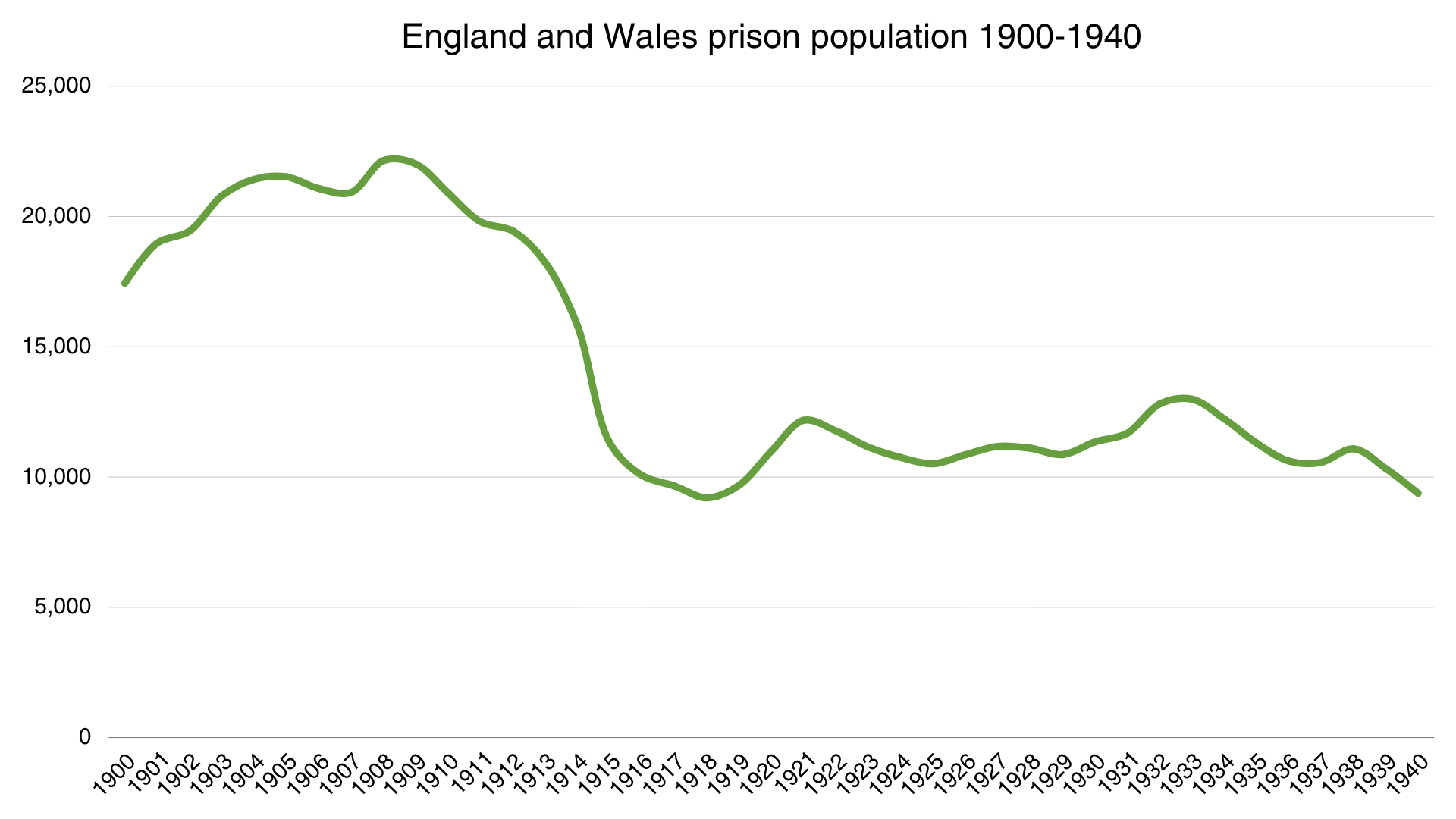
This chart shows dramatic reductions in the prison population achieved in the 1910s and maintained throughout the 1920s and 1930s.
In 1905 the prison population stood at 21,525 and was on the rise. The new Home Secretary, Herbert Gladstone, had long been cynical about the effectiveness of imprisonment. He is best known to prison historians as the author of the 1895 Gladstone report, which introduced the aim of reformation into English prisons. Gladstone introduced a number of initiatives, including: the creation, in 1907, of a statutory probation service tasked to “advise, assist and befriend” as an alternative to prison; the establishment of Borstal for young men; the introduction of children’s courts; and legislation requiring magistrates to allow those they fined time to pay by instalments.
Although Gladstone left office in 1910, under his successors, Winston Churchill (1910-1911) and Reginald McKenna (1911-1915), these initiatives were to have a dramatic impact on the size of the prison population. The average daily population more than halved from 21,525 in 1905 to 9,199 in 1918. Even more dramatic than the halving of the daily population was the reduction in overall number of people imprisoned. Whereas previously fines not paid immediately resulted in short-terms of imprisonment, by allowing people time to pay, the number of prison receptions reduced dramatically, from approximately 200,000 people in 1903, to 30,000 by 1918. Nearly six out of seven people entering prison in 1903 would not have been incarcerated 15 years later.
The first two decades of the 20th century show that a dramatic decrease in prison population is achievable. The vision of Gladstone, Churchill and McKenna was turned into legislation intended to dramatically reduce the prison population. What is possibly even more remarkable is that for the following two decades this reduced level was maintained. It is even more remarkable when you consider the context. Whilst the first two decades had seen little change in the level of recorded crime (in the 1900s an average increase of 3% and the 1910s a small decline), the 1920s saw an increase of crime of nearly 50%, and in the 1930s the rate of recorded crime doubled.
The prison population of England and Wales in 1940 stood at 9,377 and had, over the previous 20 years, always remained under 13,000
Official crime statistics are notoriously unreliable, but the 1920s and 1930s were a time of considerable social conflict and increased poverty. The depression, mass unemployment, and the policing of the 1926 General Strike would all have suggested an increased use of imprisonment. So would the rapid increase in the number of motor vehicles on the roads, from under 200,000 in 1920 to over a million by 1930 and two million by 1940. The moral panics over motor bandits in the 1930s shows the potential increase in criminal opportunities the car brought was well appreciated at the time. Despite these pressures the prison population of England and Wales in 1940 stood at 9,377 and had, over the previous 20 years, always remained under 13,000.
To understand this, we need to look beyond crime statistics and explore how government policy and wider social factors influenced penal policy. The full explanation for this relative penal restraint is complex but I’d like to highlight three key factors. Firstly, austerity. The recommendations of the Geddes committee on National Expenditure led to substantial reductions in public spending during the 1920s. The low level of imprisonment allowed savings to be made through the closure of some prisons. As the prison estate contracted it in turn required the reduced level of imprisonment to be maintained.
Secondly, the secrecy which had characterised life in prison was penetrated by the well-publicised experience of political prisoners. The account of Lady Constance Lytton’s treatment in prison, disguised as a seamstress, made many of her fellow aristocrats question the punishment. Similarly, the investigations of the Prison System Enquiry Committee and their report, English Prisons Today, deployed the first hand experiences of imprisoned conscientious objectors to expose the reality of life behind bars. With others, these public interventions by imprisoned upper- and middle-class suffragettes and World War One conscientious objectors meant an influential section of public opinion was better informed about the reality of imprisonment. This in turn resulted in influential sections of public opinion being increasingly critical of both existing prison regimes and the potential effectiveness of imprisonment.
Thirdly, throughout the 1920s and 1930s English prison administration was dominated by the charismatic Alexander Paterson, whose influence over politicians and newspaper editors meant that, despite increasing crime levels, and the Dartmoor mutiny, they largely avoided passing more punitive laws or making popularist calls for harsher sentences. Paterson’s impact, alongside the influence of imprisoned suffragettes and conscientious objectors, created a political consensus for penal moderation that magistrates and judges reflected in their sentencing.
1940-1993: Steady growth
The story after 1940 is very different as we can see from the second chart below.
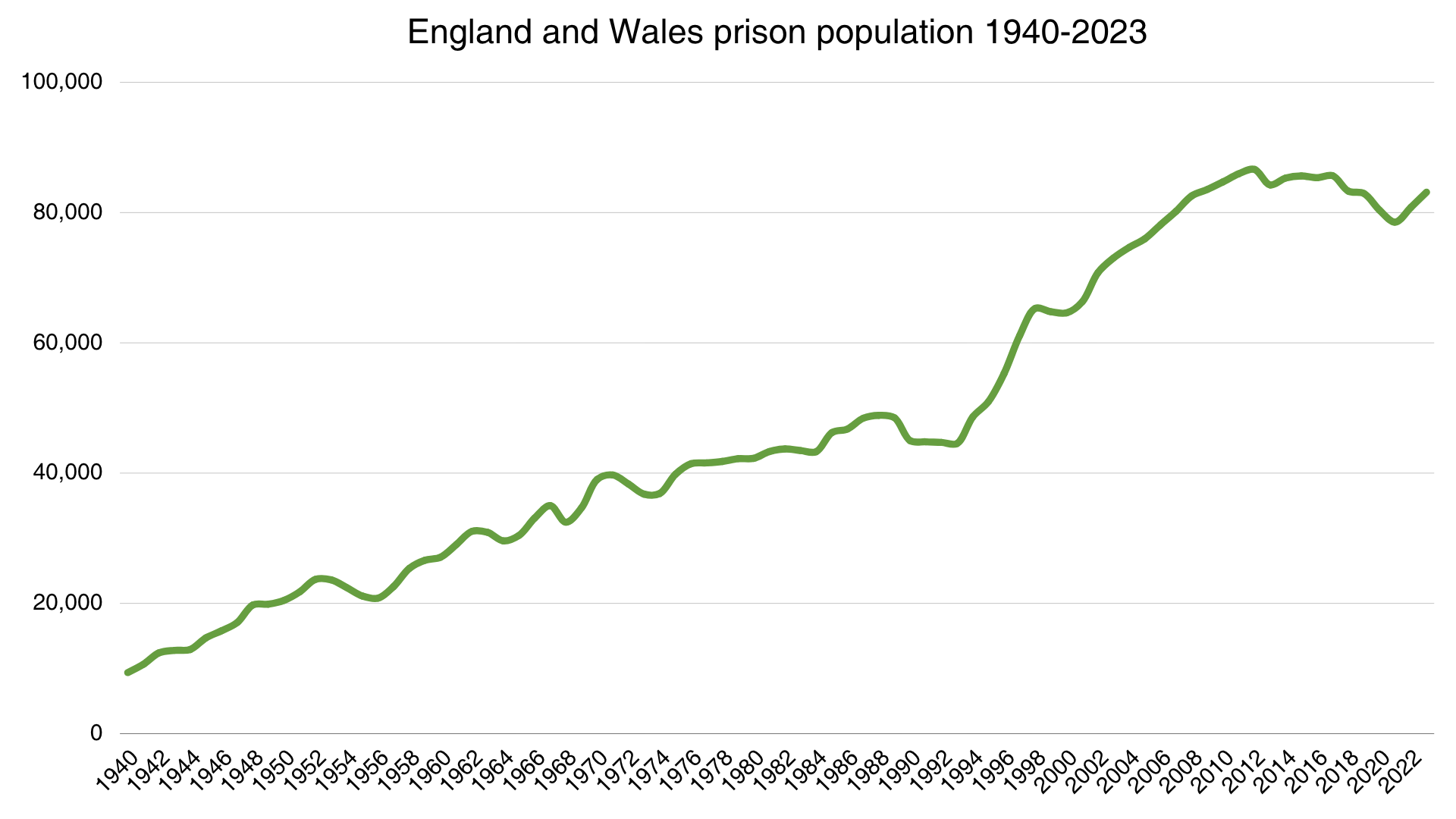
In the 1940s the prison population doubled. All the reductions and restraints of the previous 40 years were reversed and a steady upward trend was established over the next 50 years. Unlike the period up until the second world war, where specific policy decisions can be identified that determined the prison population, the post-war period is more confused. In particular, following the rhetoric of policy makers sheds little light on penal practice. Although the 1950s, the 1960s and the 1970s are often portrayed as a period of enlightenment, where an informed and liberal elite saw themselves as the ‘platonic guardians’ of penal policy, prison populations grew steadily and progressive inter-war initiatives such as borstals degenerated. Whilst the Thatcher government (1979-1990) was characterised by a dramatic intensification of punitive rhetoric, the prison population remained relatively stable, rising by just 0.5% per year. This compared to an average increase under Harold Wilson’s (1964-1970 & 1974-1976) of just under 6% across his eight years in office.
This period is the most difficult to analyse because the key factors appear to be absences. Crime undoubtably became a far greater issue for public opinion and politicians of all parties were increasingly willing to exploit the potential of talking tough on crime. Recorded crime continued to rise, sometimes rapidly, but there is no direct correlation between crime rates and imprisonment rates.
On the one hand political rhetoric and media commentary was becoming more punitive, whilst civil servants, prison service managers and the restraint of sentencers were acting as restraints on penal expansion
Austerity had an impact, but in a different way. In the immediate post-war period restrictions on public expenditure did concern the Home Office, but they led to innovation rather than restraint. With no funds available for prison building, former armed forces bases were rapidly absorbed into the prison estate allowing the Atlee government (1945-1951) to maintain an average increase of the population of over 8% without any new prisons being built.
The late 1970s and early 1980s also saw attempts to restrain public expenditure, and this coincided with a period of stability. Prison populations declined in 1983 and 1984, although the extent to which this was connected with economic policy is the subject of ongoing research. The period between 1983 and 1993 was a period which saw little change in the prison population. In 1982 the England and Wales prison population stood at 43,707. By 1993 this had risen 44,552, an increase of less than 100 a year. Further research is needed to untangle exactly what was going on during this period. On the one hand political rhetoric and media commentary was becoming more punitive, whilst civil servants, prison service managers and the restraint of sentencers were acting as restraints on penal expansion.
Dr John Moore is a former Fellow of the Institute of Historic Research, who has held academic posts at a number of universities.
Comments
Leave a Reply
-
Join the Howard League
We are the world's oldest prison charity, bringing people together to advocate for change.
Join us and make your voice heard -
Support our work
We safeguard our independence and do not accept any funding from government.
Make a donation
This is fascinating and must have taken a great amount of research. To see the development of the use of imprisonment – or not in the early part of the 20th century – is eye-opening. I must move on to Part 2 immediately!