Howard League blog · 4 Jun 2026
Choosing how many to imprison: Some lessons from the 20th century history of English prisons (Part 2 of 2)
This is the second instalment of a two-part blog series by Dr John Moore, which charts the fall and rise of the prison population over the 20th century, from a low of under 10,000 to over 80,000 people, and highlights some of the key factors determining just how many people were incarcerated in England and Wales.
This blogpost deals with the period from 1993 to present day. The first instalment covered the periods 1900-1940 and 1940-1993.
Rapid expansion
From 1993 the prison population expanded dramatically. A prison population in 1993 of 44,552 had within five years risen by over 20,000 to stand at 65,299 in 1998.
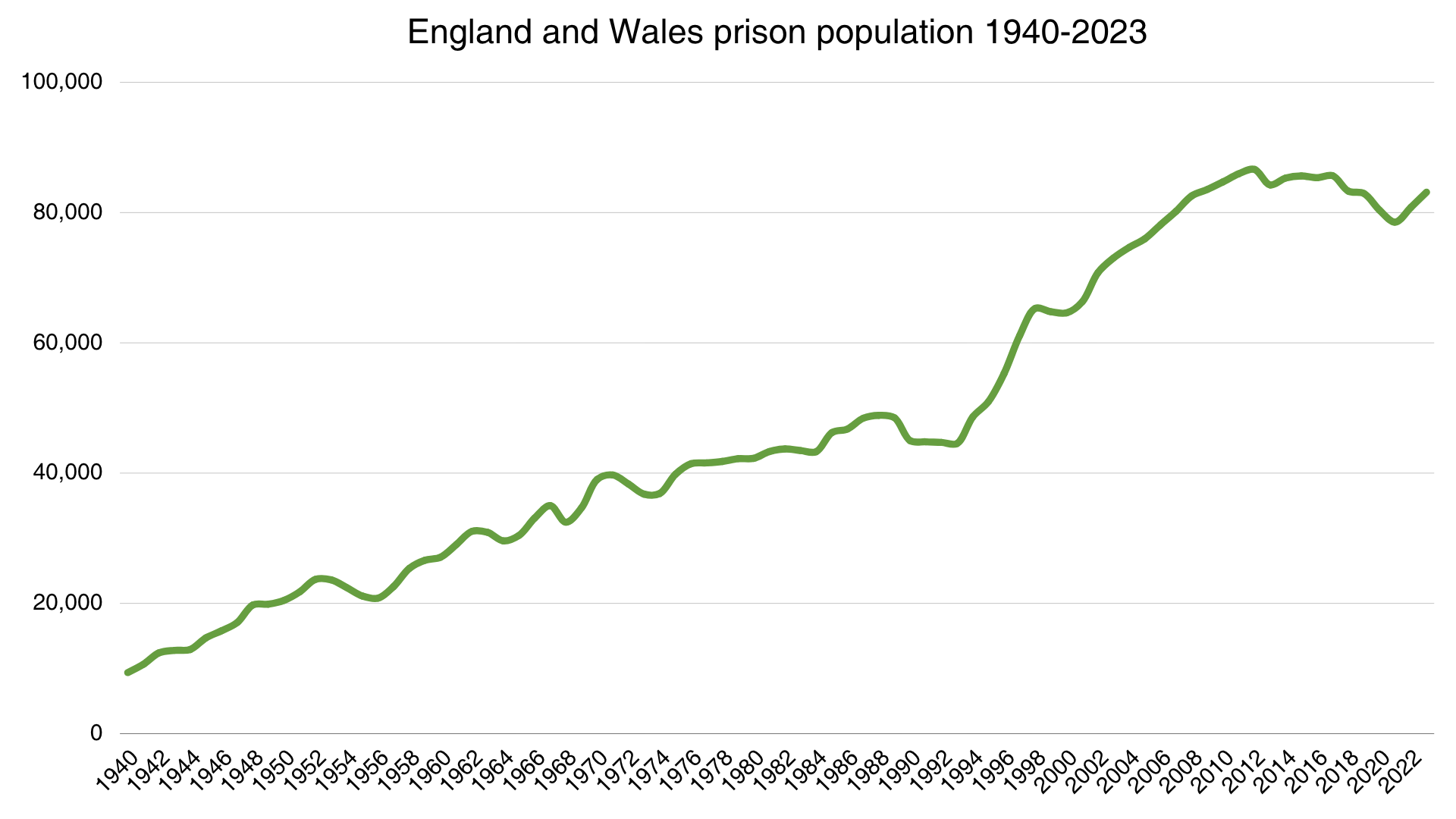
The punitive rhetoric of politicians and the media over the previous 20 years had undoubtably prepared for this expansion, but the trigger for it was the 1993 killing of James Bulger by two 10-year-old boys. Despite being an exceptional event, it had a significant impact on political and media discourse and, subsequently, on the prison population.
The then Home Secretary, Michael Howard, responded to the tragic killing by declaring to the 1993 Conservative conference ‘prison works’; whilst announcing 27 specific measures, many that would lead to increased imprisonment, and the financing of six private sector prisons. His Labour shadow, Tony Blair, responded by asserting at his party’s conference that “Labour is the party of law and order in Britain today. Tough on crime and tough on the causes of crime.”
A climate was created where it was impossible for the platonic guardians to maintain any restraint on prison numbers. Legislation increased sentences, magistrates and judges reflected the new culture by sending more people to prison and for longer. This increase happened at the same time that recorded crime fell.
New prison building provided increased capacity, allowing more people to be imprisoned. However, the increased rate of incarceration often outstripped the building programme, leading to increased overcrowding and the inevitable impact this had on the quality of prison regimes.
A climate was created where it was impossible for the platonic guardians to maintain any restraint on prison numbers.
Just as the reductions of the prison population in the early part of the century had been partially facilitated by removing certain categories of prisoners, most notably those unable to pay fines immediately, the expansion at the end of the century was partially the result of imprisoning those who in previous years would have received non-custodial sentences. This had disproportionate impacts on some groups. For example, women, who statistically are convicted of less serious offences, saw a disproportionate increase as the female prison population tripled between 1994 and 2005.
The rapid prison population increase that started in 1993 continued into the next century, reaching a peak of 86,634 in 2012.
The trend came to a halt with the election of the Conservative/Liberal Democrat coalition government in 2010, bringing with it combination of austerity measures and a Justice Secretary who believed too many people were imprisoned. Declaring that ‘prison is a waste of money’, Kenneth Clarke was able to use public expenditure cuts as an opportunity to stop the increase and, for a few years, slightly reduce the overall number.
However, by 2024 a new record of over 88,000 people in prison was reached, and current official projections estimate it will continue to rise to over 100,000 by March 2030.
Lessons from 20th century history
The key lessons from this brief account of English prison history are, firstly, the need for a much more honest acknowledgement that levels of imprisonment are ultimately a political decision or at other times a political indecision. This is illustrated most clearly in the first part of the century and the end of the century.
The 1905 Liberal government’s home secretaries made clear policy decisions to reduce the level of imprisonment. By co-ordinated legislative and administrative action, the daily average prison population was halved, prison admissions reduced by 85%. Events after 1993 show again how political decisions can impact, with a series of legislative and administrative actions resulting in increases as dramatic as the reductions of earlier in the century.
Governments can, if they want, imprison fewer people. It really is that simple.
Between these two dramatic shifts we see further evidence of the importance of political leadership. In the 1920s and 1930s the radical reduced level of imprisonment inherited from earlier in the century was maintained, despite the depression and rising crime rates, because decision makers resolved that it should. In the period after the second world war this commitment waned and we saw prison numbers drift upwards in the absence of sustained political will, despite attempts by administrators to restrict growth. Whilst the increasingly punitive rhetoric of politicians and media from the 1970s was not immediately incorporated in policy, it created the environment which, ignited by the cross-party exploitation of the tragic killing of James Bulger, facilitated the rapid expansion at the end of the century.
Despite a brief pause in the 2010s, the prison population growth of the 20th century has resumed. Political and media rhetoric continues to represent crime rising and requiring an increasingly punitive response despite clear evidence of a decline in crime statistics. This is accompanied by legislative and administrative decisions that lead to more people being imprisoned and sentences continuing to get longer. Whilst the government invests billions in building new prisons, the prison population increases, continuing to outstrip the building programme.
Avoiding the inevitable crisis that will occur when the prison estate runs out of capacity is actually quite simple. How many we incarcerate is a political decision. Governments can, if they want, imprison fewer people. It really is that simple.
Dr John Moore is a former Fellow of the Institute of Historic Research, who has held academic posts at a number of universities.
Comments
Leave a Reply
-
Join the Howard League
We are the world's oldest prison charity, bringing people together to advocate for change.
Join us and make your voice heard -
Support our work
We safeguard our independence and do not accept any funding from government.
Make a donation
There seems very little common sense in all the changes we have seen since the 1970s. An education system which is more concerned with pushing people into trained boxes than educating them to think and make good decisions, no creativity, no funding for youth services, low taxes for the wealthiest and increasing reductions in checks and balances of big business whilst the poorest are kept on the end of an internet dog chain accounting to the system at the drop of a hat.
I hadn’t connected the Bulger case to the changes in rhetoric, i just thought Howard was a g*t like the rest of them. What Blaire have with one hand he took away with the other, but no one has been as punitive as the Tories during the last 15 years. I can’t see any common sense on the horizon. Not now the right wing billionaires are running the world.
We’ve been living in a gangster’s paradise.